Today
20
in History
26
January
February
March
April
May
June
July
August
September
October
November
December
01
Wed
02
Thu
03
Fri
04
Sat
05
Sun
06
Mon
07
Tue
08
Wed
09
Thu
10
Fri
11
Sat
12
Sun
13
Mon
14
Tue
15
Wed
16
Thu
17
Fri
18
Sat
19
Sun
20
Mon
21
Tue
22
Wed
23
Thu
24
Fri
25
Sat
26
Sun
27
Mon
28
Tue
29
Wed
30
Thu
...
04-07-1954
President Eisenhower presents Cold War “domino theory”
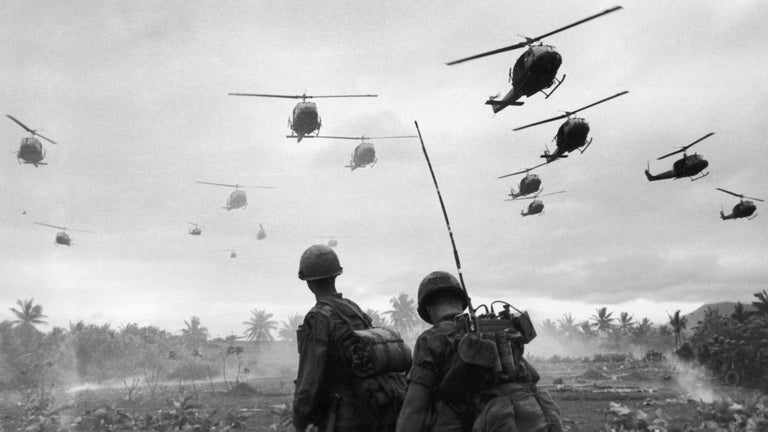
President Dwight D. Eisenhower coins one of the most famous Cold War phrases when he suggests the fall of French Indochina to the communists could create a “domino” effect in Southeast Asia. The so-called “domino theory” dominated U.S. thinking about Vietnam for the next decade.
By early 1954, it was clear to many U.S. policymakers that the French were failing in their attempt to re-establish colonial control in Indochina (Vietnam), which they lost during World War II when the Japanese took control of the area. The Vietnamese nationalists, led by the communist Ho Chi Minh, were on the verge of winning a stunning victory against French forces at the battle of Dien Bien Phu. In just a few weeks, representatives from the world’s powers were scheduled to meet in Geneva to discuss a political settlement of the Vietnamese conflict. U.S. officials were concerned that a victory by Ho’s forces and/or an agreement in Geneva might leave a communist regime in control of all or part of Vietnam. In an attempt to rally congressional and public support for increased U.S. aid to the French, President Eisenhower gave a historic press conference on April 7, 1954.
He spent much of the speech explaining the significance of Vietnam to the United States. First was its economic importance, “the specific value of a locality in its production of materials that the world needs” (materials such as rubber, jute, and sulphur). There was also the “possibility that many human beings pass under a dictatorship that is inimical to the free world.” Finally, the president noted, “You have broader considerations that might follow what you would call the ‘falling domino’ principle.” Eisenhower expanded on this thought, explaining, “You have a row of dominoes set up, you knock over the first one, and what will happen to the last one is a certainty that it will go over very quickly.” This would lead to disintegration in Southeast Asia, with the “loss of Indochina, of Burma, of Thailand, of the Peninsula, and Indonesia following.” Eisenhower suggested that even Japan, which needed Southeast Asia for trade, would be in danger.
Eisenhower’s words had little direct immediate impact–a month later, Dien Bien Phu fell to the communists, and an agreement was reached at the Geneva Conference that left Ho’s forces in control of northern Vietnam. In the long run, however, Eisenhower’s announcement of the “domino theory” laid the foundation for U.S. involvement in Vietnam. John F. Kennedy and Lyndon B. Johnson both used the theory to justify their calls for increased U.S. economic and military assistance to non-communist South Vietnam and, eventually, the commitment of U.S. armed forces in 1965.
More news today
loading...