Today
20
in History
26
January
February
March
April
May
June
July
August
September
October
November
December
01
Wed
02
Thu
03
Fri
04
Sat
05
Sun
06
Mon
07
Tue
08
Wed
09
Thu
10
Fri
11
Sat
12
Sun
13
Mon
14
Tue
15
Wed
16
Thu
17
Fri
18
Sat
19
Sun
20
Mon
21
Tue
22
Wed
23
Thu
24
Fri
25
Sat
26
Sun
27
Mon
28
Tue
29
Wed
30
Thu
31
Fri
...
07-21-2011
NASA’s final space shuttle mission comes to an end
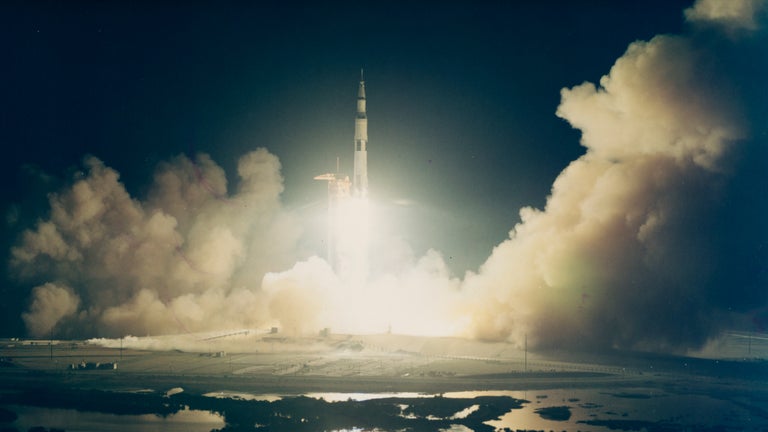
On July 21, 2011, NASA’s space shuttle program completes its final, and 135th, mission, when the shuttle Atlantis lands at Kennedy Space Center in Florida. During the program’s 30-year history, its five orbiters—Columbia, Challenger, Discovery, Atlantis and Endeavour—carried more than 350 people into space and flew more than 500 million miles, and shuttle crews conducted important research, serviced the Hubble Space Telescope and helped in the construction of the International Space Station, among other activities. NASA retired the shuttles to focus on a deep-space exploration program that could one day send astronauts to asteroids and Mars.
In January 1972, two-and-a-half years after America put the first man on the moon in July 1969, President Richard Nixon publicly announced that NASA would develop a space transportation system featuring a space vehicle capable of shuttling “repeatedly from Earth to orbit and back.” Nine years later, on April 12, 1981, at Kennedy Space Center, the first shuttle, Columbia, lifted off on its inaugural mission. Over the course of the next 54 hours, the two astronauts aboard NASA’s first reusable spacecraft successfully tested all its systems and orbited the Earth 37 times before landing at Edwards Air Force Base in California.
In 1983, a second shuttle, Challenger, was put into service. It flew nine missions before breaking apart shortly after the launch of its 10th mission, on January 28, 1986. All seven crew members were killed, including high school teacher Christa McAuliffe, who had won a national contest to be the first U.S. civilian to fly aboard the space shuttle. In the aftermath of the disaster, the shuttle program was grounded until 1988.
The program’s third shuttle, Discovery, made its first flight in 1984. Atlantis entered the fleet in 1985, and was followed by Endeavour in 1992. The shuttle program experienced its second major disaster on February 1, 2003, when just minutes before Columbia was scheduled to land at Kennedy Space Center and conclude its 28th mission, it broke apart while re-entering the atmosphere over Texas. All seven astronauts on board perished.
Afterward, the shuttle fleet was grounded until July 2005, when Discovery was launched on the program’s 114th mission. By the time Discovery completed its 39th and final mission (the most of any shuttle) in March 2011, it had flown 148 million miles, made 5,830 orbits of Earth and spent 365 days in space. Endeavour completed its 25th and final mission in June 2011. That mission was commanded by Capt. Mark Kelly, husband of former U.S. congresswoman Gabrielle Giffords.
On July 8, 2011, Atlantis was launched on its 33rd mission. With four crew members aboard, Atlantis flew thousands of pounds of supplies and extra parts to the International Space Station; it was the 37th shuttle flight to make the trip. Thirteen days later, on July 21, Atlantis touched down at Kennedy Space Center at 5:57 a.m., after a journey of more than 5 million miles, during which it orbited the Earth 200 times. Upon landing, the flight’s commander, Capt. Christopher J. Ferguson, said, “Mission complete, Houston. After serving the world for over 30 years, the space shuttle has earned its place in history, and it’s come to a final stop.” During its 26 years in service, Atlantis flew almost 126 million miles, circled Earth 4,848 times and spent 307 days in space. The estimated price tag for the entire space shuttle program, from development to retirement, was $209 billion.
More news today
loading...