Today
20
in History
26
January
February
March
April
May
June
July
August
September
October
November
December
01
Thu
02
Fri
03
Sat
04
Sun
05
Mon
06
Tue
07
Wed
08
Thu
09
Fri
10
Sat
11
Sun
12
Mon
13
Tue
14
Wed
15
Thu
16
Fri
17
Sat
18
Sun
19
Mon
20
Tue
21
Wed
22
Thu
23
Fri
24
Sat
25
Sun
26
Mon
27
Tue
28
Wed
29
Thu
30
Fri
31
Sat
...
10-14-1890
Dwight D. Eisenhower is born
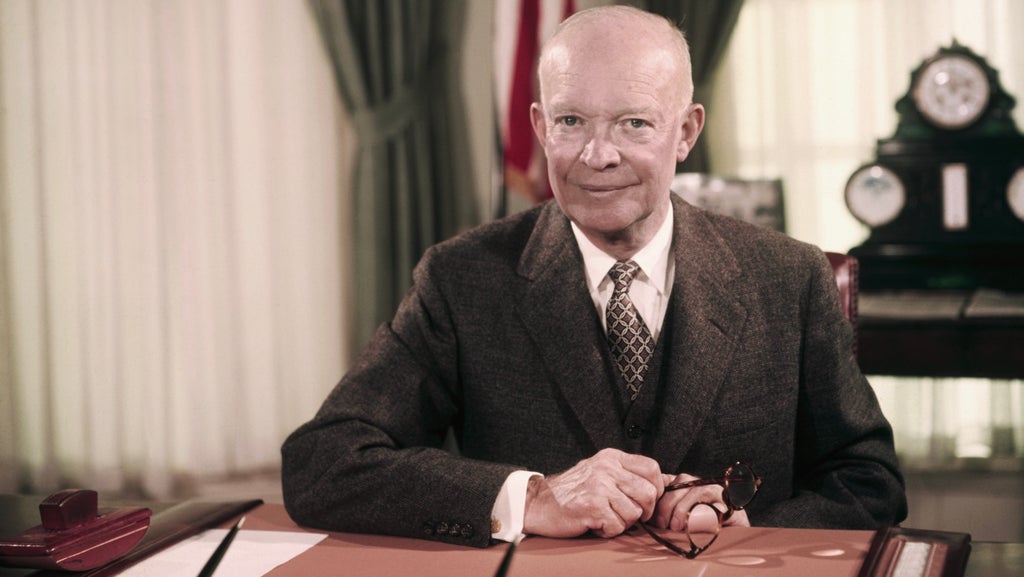
Future president Dwight D. Eisenhower is born in Denison, Texas on October 14, 1890.
After graduating from West Point in 1915, Eisenhower embarked on a stellar military career—he would eventually become the supreme commander of Allied forces in Europe during World War II and the leader of the invasion of Normandy in June 1944. Following the war, “Ike,” as he was affectionately called, served as president of Columbia University until 1951, when he became supreme commander of NATO forces in Europe. The next year, Eisenhower beat out Democrat Adlai Stevenson to become president of the United States.
The Cold War and a determination to prevent the spread of communism permeated Eisenhower’s foreign and domestic policies. During his first term, Eisenhower oversaw the end of the Korean War (1950 – 1953), the first major diplomatic and military confrontation between America and a powerful communist foe. (Communist China had intervened on behalf of communist North Korea in its war with South Korea, which was aided by the United States.) At home, Eisenhower supported and encouraged efforts to root out potential communist spies in America, but privately expressed disgust at the shameless tactics used by Senator Joseph McCarthy during the HUAC (House Un-American Activities Committee) hearings. In July 1955, Ike’s attention turned toward communist Russia: He led a conference of world leaders in Geneva with the goal of improving relations with the Russians. Following the meetings, Eisenhower returned to the states, encouraged by what he saw as a small crack in the icy reserve of the Russian leadership.
Ike’s busy presidential schedule was interrupted in September 1955 when he suffered a heart attack that restricted his activity for nearly two months. Stoic and resilient, Eisenhower recovered to embark on a second presidential campaign in 1956; he won easily. During his two terms, Eisenhower witnessed the rise of a powerful political and economic alliance between America’s military and its industries might wield too much influence over American domestic and foreign affairs and warned Americans of what he called a “military-industrial complex” in his now famous farewell speech, televised across the nation on January 17, 1961.
After leaving the White House, Eisenhower and his wife Mamie traveled and remained active in public life and in the Republican Party. Their grandson, David, married President Richard Nixon’s daughter Julie in 1968. The next year, Eisenhower died of heart failure in Walter Reed Army Hospital, with Mamie at his side.
More news today
loading...