Today
20
in History
26
January
February
March
April
May
June
July
August
September
October
November
December
01
Thu
02
Fri
03
Sat
04
Sun
05
Mon
06
Tue
07
Wed
08
Thu
09
Fri
10
Sat
11
Sun
12
Mon
13
Tue
14
Wed
15
Thu
16
Fri
17
Sat
18
Sun
19
Mon
20
Tue
21
Wed
22
Thu
23
Fri
24
Sat
25
Sun
26
Mon
27
Tue
28
Wed
29
Thu
30
Fri
31
Sat
...
10-14-1855
Grim History of London's Speakers' Corner
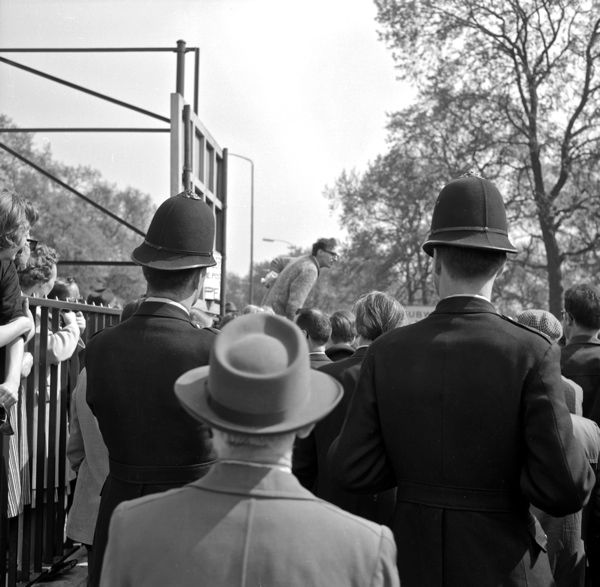
October 14, 1855 — A carpenter mounted his soapbox on this day complaining about high food prices – and became the first recorded amateur orator to address a crowd at what was to become Speakers’ Corner in London’s Hyde Park.
Writer George Orwell later described the place as "one of the minor wonders of the world", where he had listened to "Indian nationalists, temperance reformers, Communists, Trotskyists, the Socialist Party of Great Britain, the Catholic Evidence Society, freethinkers, vegetarians, Mormons, the Salvation Army, the Church Army, and a large variety of plain lunatics".
The freedom of speech that they all enjoyed was won formally in the mid-18th Century when the Chartists held mass protests in this area of Hyde Park to press for the rights of working people, including the right of assembly.
At the same, the Reform League, which fought for the right to vote for every adult male, organised rallies nearby.
Finally, the Government bowed to popular pressure and passed a law granting the fundamental right of citizens to gather together to hear and be heard – and Speakers’ Corner was born.
Its origins, though, go back centuries. Here stood the notorious Tyburn Hanging Tree, which had been used for public executions as early as 1108.
Hanging days were declared a public holiday and caused much excitement. The condemned were taken from Newgate Prison to Tyburn on a cart and had to ride with the hangman and the prison chaplain.
Raucous crowds gathered along the two-mile route and windows overlooking it were crowded. Cheering, jeering, preaching and shouting accompanied the procession on its three-hour journey.
It was said that the execution of 22-year-old highwayman Jack Sheppard in 1724 attracted a crowd of 200,000. Londoners, it seems, had always considered it “quite an outing” to see a “good hanging”!
To cope with demand, a six-metre high triangular-shaped gallows had replaced the Hanging Tree in 1571. Each beam could accommodate eight people, and so – before an enthusiastic crowd – twenty-four victims could swing to their deaths in one go.
Before departing, however, they were allowed to speak to the crowd and often argued with onlookers as they denounced the State, or the Church, or simply protested their innocence.
So the principle of free speech and public debate, even if it was watched over by officers of the law, was established. It continues in similar fashion to this day at the same spot – Speakers’ Corner.
More news today
loading...